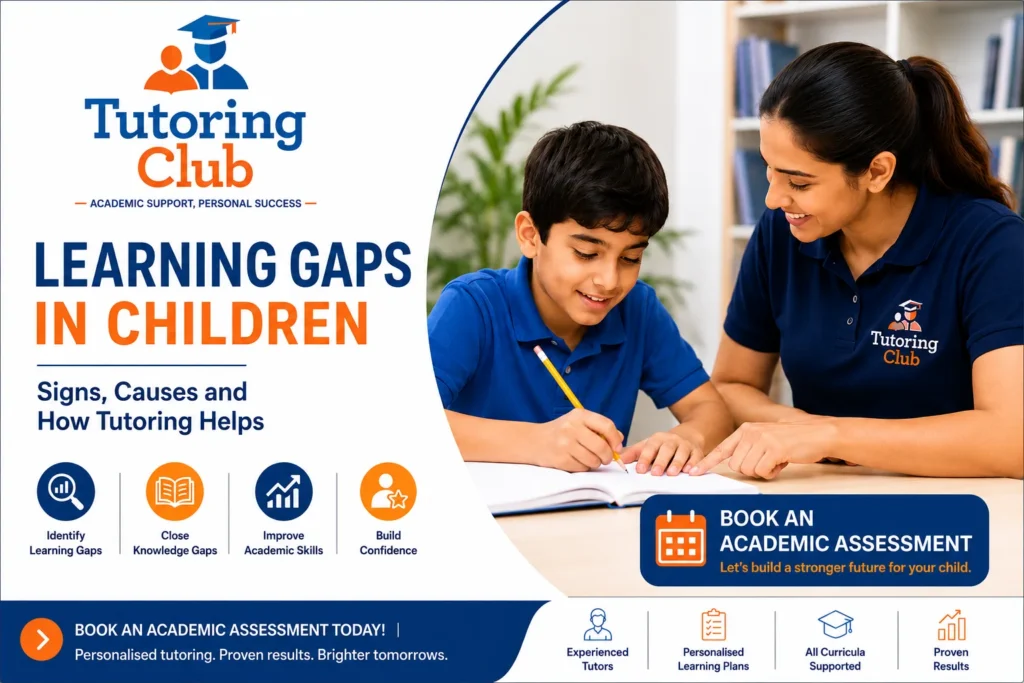
Learning gaps occur when a child has not fully understood or mastered an important skill before moving on to more advanced work. These gaps can develop gradually and may affect a student’s confidence, classroom participation, homework and academic performance.
A child may appear to be struggling with a current topic when the real difficulty comes from an earlier skill that was never fully understood. For example, a student finding algebra difficult may have gaps in fractions, number operations or basic problem-solving. A child struggling with reading comprehension may need additional support with vocabulary, fluency or sentence structure.
Tutoring Club helps students identify and address learning gaps through personalised academic assessments and targeted tutoring. By strengthening essential foundations, students can approach new material with greater confidence and make more consistent progress at school.
What Is a Learning Gap?
A learning gap is the difference between what a student is expected to know at a particular grade level and what they can currently understand or do independently.
Learning gaps can be small and focused, such as difficulty with multiplication facts, punctuation or paragraph structure. They can also affect several connected skills and make new topics increasingly difficult.
Because school subjects build on previous knowledge, an unresolved gap can continue to affect a student as the curriculum becomes more demanding. Early identification can prevent a temporary difficulty from becoming a longer-term academic problem.
Common Signs of Learning Gaps
Learning gaps do not always appear as low grades. Some students work hard to compensate for missing skills, while others become quiet, distracted or reluctant to participate.
Parents may notice that their child:
- Takes much longer than expected to complete homework
- Repeatedly makes the same mistakes
- Understands a topic during a lesson but forgets it later
- Avoids reading, writing or certain Maths tasks
- Struggles to explain how they reached an answer
- Relies heavily on help from parents or teachers
- Has difficulty applying knowledge to unfamiliar questions
- Becomes frustrated or anxious about schoolwork
- Has falling grades despite continued effort
- Lacks confidence in a particular subject
One sign alone may not indicate a serious problem. However, repeated difficulty with the same skills may suggest that further assessment and targeted support are needed.
What Causes Learning Gaps?
Learning gaps can develop for many reasons. They are not necessarily a sign that a student lacks ability or motivation.
Common causes include:
- Missing school because of illness, travel or relocation
- Moving between different school curricula
- Progressing before a topic was fully understood
- Changes in teachers or teaching methods
- Limited practice and revision
- Difficulty concentrating in a busy classroom
- Learning remotely for an extended period
- Gaps in reading or language development
- Exam pressure or low academic confidence
- Differences in the pace at which students learn
Students who move between British, IB, American or other international school systems may also encounter topics taught in a different order. This can create gaps even when the student previously performed well.
Why Learning Gaps Can Become More Serious
Most academic subjects are cumulative. New knowledge depends on skills learned earlier.
In Maths, difficulty with number operations can later affect fractions, algebra and problem-solving. In English, weak vocabulary or reading fluency can affect comprehension, writing and performance across other subjects. In Science, missing basic concepts can make more advanced explanations difficult to understand.
When these foundations remain weak, students may begin memorising procedures without understanding them. This can work temporarily, but it becomes less effective when questions require reasoning, application or independent thinking.
Addressing gaps early helps students rebuild the knowledge they need before the curriculum becomes more challenging.
How Academic Assessments Identify Learning Gaps
An academic assessment helps identify what a student understands confidently and where support is required. It should look beyond the student’s current grade and examine the foundational skills connected to the areas of difficulty.
An assessment may review:
- Reading accuracy and comprehension
- Vocabulary and written expression
- Grammar, punctuation and spelling
- Number skills and calculations
- Fractions, decimals and percentages
- Mathematical reasoning and problem-solving
- Subject knowledge appropriate to the student’s grade
- Accuracy, confidence and working pace
The results allow tutors to create a focused learning plan rather than repeating an entire school curriculum. This helps the student spend more time on the skills that will make the greatest difference.
How Personalised Tutoring Helps Close Learning Gaps
Personalised tutoring allows students to work at a pace suited to their current level. Instead of moving on because the class has completed a topic, the tutor can revisit important concepts, explain them differently and provide enough guided practice for the student to develop confidence.
Effective tutoring may include:
- Breaking difficult topics into smaller steps
- Revisiting missing foundational skills
- Using examples suited to the student’s level
- Providing immediate feedback
- Correcting misunderstandings before they become habits
- Connecting earlier skills to current schoolwork
- Practising until the student can work independently
- Monitoring progress and adjusting the learning plan
The aim is not only to improve a test score. It is to help the student understand the subject more securely and become less dependent on support over time.