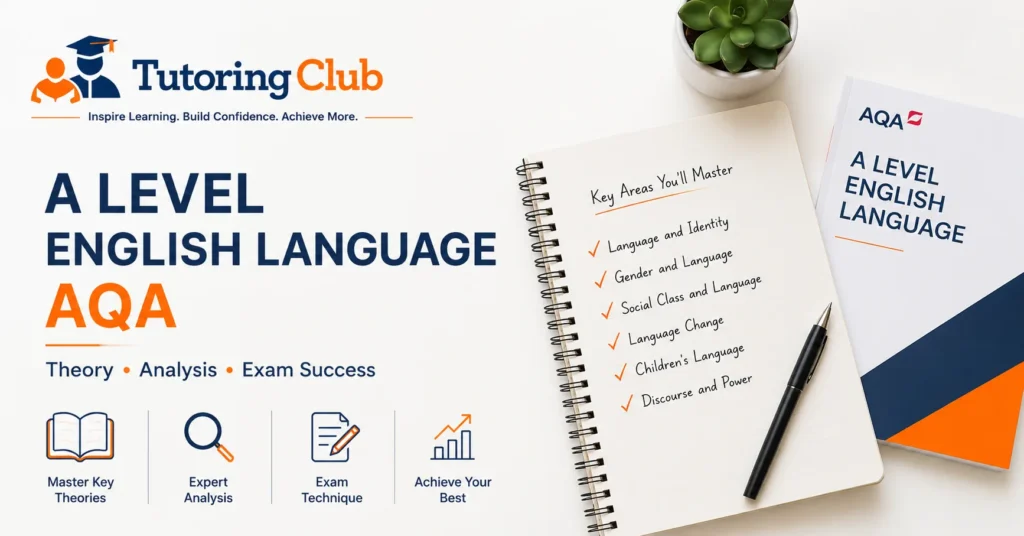
If you’re studying A Level English Language AQA, you’re developing far more than essay-writing skills. This subject explores how language shapes identity, power, culture and communication. From analysing spoken conversations to evaluating media texts and investigating language change, A Level English Language equips students with analytical skills that are highly valued by universities and employers alike.
Whether you’re aiming for an A*, preparing for your final examinations or simply trying to improve your confidence, understanding the structure of the course and mastering the key theories can make a significant difference.
What Is A Level English Language AQA?
The AQA A Level English Language course examines how English is used in real-life contexts.
Students explore:
- Language and gender
- Language and occupation
- Language and social groups
- Language diversity
- Language change
- Child language acquisition
- Language discourses
- Writing for different audiences
- Language investigation
- Original writing
Unlike GCSE English, A Level English Language focuses heavily on linguistic analysis rather than literature.
Course Structure
The course consists of three main components.
Paper 1
Language, the Individual and Society
Topics include:
- Textual variations
- Child language development
- Language diversity
- Language analysis
Paper 2
Language Diversity and Change
Students study:
- Regional dialects
- Accent variation
- Language and gender
- Social class
- Language change
- Global English
- World Englishes
Students also produce extended analytical essays.
Non-Exam Assessment (NEA)
Students complete:
- Language Investigation
- Original Writing
The coursework contributes significantly towards the final grade.
Key Theories Every Student Should Know
Successful students consistently reference major linguists.
Important theorists include:
- Robin Lakoff
- Deborah Tannen
- Jennifer Coates
- William Labov
- Basil Bernstein
- Peter Trudgill
- Jean Aitchison
- David Crystal
- Penelope Eckert
- Howard Giles
- Janet Holmes
Understanding the strengths and limitations of each theory is just as important as memorising them.
How to Achieve Top Grades
Students aiming for A or A* typically:
- Use linguistic terminology accurately.
- Apply theories critically.
- Evaluate competing viewpoints.
- Analyse language rather than describe it.
- Support arguments using textual evidence.
- Write balanced conclusions.
Examiners reward evaluation, not memorisation.
Common Mistakes Students Make
Many students lose marks because they:
- Simply identify language features.
- Forget to evaluate theories.
- Overuse quotations.
- Ignore context.
- Memorise essays instead of learning concepts.
- Fail to compare different viewpoints.
Revision Tips
Effective revision includes:
- Creating theory summary sheets.
- Practising timed essays.
- Annotating unseen texts.
- Revising terminology.
- Comparing theorists.
- Completing past AQA papers.
Consistency is more effective than last-minute cramming.
Recommended Revision Resources
Students should regularly use:
- Official AQA specification
- Examiner reports
- Past papers
- Mark schemes
- Flashcards
- Theory comparison tables
Why Many Students Choose One-to-One Tutoring
A Level English Language can be challenging because every essay requires analysis, evaluation and independent thinking.
Working with an experienced tutor helps students:
- Understand difficult theories.
- Improve essay structure.
- Develop stronger analysis.
- Prepare for examinations.
- Receive personalised feedback.
Why Choose Tutoring Club Dubai?
At Tutoring Club Dubai, our experienced tutors support students studying the AQA specification through personalised one-to-one lessons.
We help students:
- Master linguistic terminology.
- Understand key theories.
- Improve examination technique.
- Strengthen essay writing.
- Prepare confidently for A Level examinations.
Our personalised approach ensures each student receives targeted support based on their strengths and learning goals.
Frequently Asked Questions
Is A Level English Language difficult?
The course is academically demanding but highly rewarding. Students who practise analysis consistently generally perform well.
How much revision should I do?
Most students benefit from regular weekly revision rather than intensive study immediately before examinations.
Is coursework included?
Yes. The NEA contributes to the overall qualification.
Which theories are most important?
Students should understand theories relating to language diversity, language change, gender, social groups and child language acquisition.
Can tutoring improve my grade?
Targeted one-to-one support often helps students strengthen analytical writing, improve confidence and develop better examination techniques.
Final Thoughts
Success in A Level English Language AQA is about understanding how language works, thinking critically and communicating ideas effectively.
With consistent practice, strong linguistic knowledge and expert guidance, students can build the confidence needed to achieve excellent results.
Whether you’re preparing for your first assessment or aiming for an A*, developing your analytical skills today will benefit both your examinations and your future academic journey.